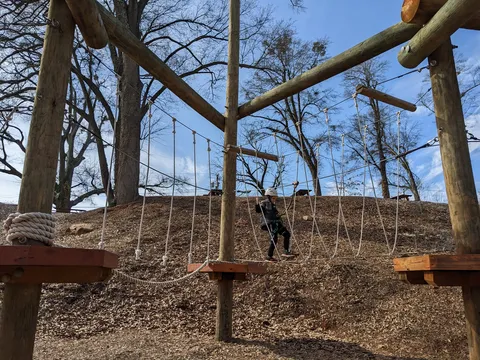
How to Pick A Company to Build a Ropes Course
If you are planning your first ropes course, or replacing an older one, this decision matters more than most people realize.
Because you are not just buying poles, cables, platforms, and gear.
You are choosing the team that will shape your program, your timeline, your budget, your guest experience, and in a lot of ways, your future.
And if you choose the wrong builder, you may not feel it on day one.
You feel it later.
When timelines go longer than expected.
When pricing changes...not in your favor.
When the design is not what you thought you were getting.
When replacement parts are harder to get.
When training feels rushed.
When support disappears after the final invoice is paid.
That is why choosing a ropes course builder should never be treated like a simple bid comparison.
Start Here, Know What You Are Really Buying
A ropes course is not just a construction project.
It is an operational system.
It has to fit your site, your audience, your staffing, your goals, and your budget. It also has to work for the long haul, not just the ribbon cutting.
We work with commercial operators, summer camps, retreat centers, colleges and universities, municipal governments, K12 schools, ROTC and the military, and similar organizations. Many are building their first course. Others are replacing one that has aged out, no longer fits their program, or needs a fresh start.
In both cases, the same mistake shows up again and again.
People shop for a builder like they are buying a commodity.
They are not.
One of the Biggest Mistakes, Choosing Whoever Is Closest
A lot of buyers start by looking for a builder near them.
That sounds reasonable.
But it can lead them in the wrong direction.
A ropes course is a specialized project. The best fit is not always the closest company. At CDI, we travel to all 50 states for projects. Distance should not be the first filter. Experience, trust, accreditation, design quality, and long-term support should come first.
If you only look nearby, you may rule out a far better partner before the process even starts.
And that can cost you a lot more than the travel ever would.
Another Big Mistake, Not Having a Budget Range in Mind
You don't need to know your exact final number on day one.
But you do need a ballpark budget.
{See our Budget Estimator to get a ballpark idea]
Without it, the process gets muddy fast.
A builder may design something much larger than you can afford. Or you may compare two proposals that look very different and assume one is simply overpriced, when really the scope is not even close to the same.
A realistic budget helps everyone.
It helps avoid wasting months chasing something that was never a fit.
Ask for References, Then Look at the Breadth of Their Work
This one matters.
Ask for references.
Not just one. Several.
And not just the easy, polished kind.
Ask to speak with clients who have had their course for a few years. Ask what happened after the build. Ask how the builder handled communication, challenges, training, follow-up, and support.
Also, look at the breadth and depth of the builder’s work.
Have they built projects like yours?
Have they worked with organizations like yours?
Have they done only one style of course, or do they have a wide range of experience?
Can they show they understand different goals, different sites, and different user groups?
A builder’s portfolio should tell you more than whether they can make something look nice.
Accreditation Matters More Than People Think
Not all builders are equal.
And not all claims of experience mean the same thing.
That is one reason we believe buyers should strongly consider an ACCT International Accredited Builder.
This accreditation is not just a logo to put on a website. It shows a level of commitment to professional standards, accountability, and industry best practices.
When you're trusting a company to help design and build an adventure experience for your guests, students, campers, or community, that matters.
A lot.
Compare Apples to Apples, Or the Numbers Will Fool You
This may be the most important advice in this whole article.
Make sure you are comparing apples to apples.
That applies to the course design. And it applies to the operational gear too.
On paper, two proposals can look wildly different in price and timeline. But that does not always mean one builder is expensive and the other is efficient.
Sometimes it means they are proposing very different things.
Yes, almost every builder can build someone else’s design.
But are they pricing the same number of elements?
The same size platforms?
The same access systems?
The same gear package?
The same level of training?
The same support?
If the concepts are not truly similar, the comparison is off from the beginning.
And once that happens, buyers can end up making a decision based on numbers that were never equal in the first place.
The Right Builder Should Make You Feel More Clear, Not More Confused
A good builder should help you understand what you are getting.
Not hide behind vague language.
Not throw out a low number that grows later.
Not gloss over key details.
They should walk you through the design.
Explain the tradeoffs.
Help you understand your options.
And tell you the truth, even when the truth is not the easiest thing to say.
That kind of clarity builds trust.
And trust matters.
Because this is not a one-call, one-check, one-install kind of decision.
At least it shouldn't be.
A Real Example of What the Right Relationship Looks Like
We had a client in Oregon working on a major commercial project.
He asked the right questions.
He took the time to get to know our staff through several meetings. And in the end, he chose Challenge Design Innovations because of the personal relationship and trust he felt with our team.
That was not a short-term decision.
And it did not become a one-time transaction.
Ten years later, we still work with that client every year.
That ongoing relationship has been incredibly valuable to them, and to us. We know their site. We know their goals. We know how they operate. And because of that, we can continue helping them make smart decisions year after year.
That is what a real builder relationship can look like.
Not one and done.
What We Believe About Long-Term Relationships
We feel strongly about this.
Very strongly.
We do not want to just be a transaction.
And honestly, we don't want clients who only want a transaction either.
At CDI, we want long-term relationships. We want partners. We want to work with people who care about using what we build in a fantastic, positive way. We want to help them operate their course well, year after year.
That means training.
Support.
Follow-up.
Service.
And a real investment in the long-term success of the program.
If someone just wants a builder to show up, install the course, and disappear, we are probably not the right fit for them.
And we are okay saying that.
Because the best projects happen when both sides want more than just a signed contract.
Questions You Should Ask Before You Choose a Builder
Here are some better questions to ask when you are evaluating ropes course builders:
Are you an ACCT International Accredited Builder?
That is one of the clearest ways to understand whether a company has made a serious commitment to the industry standards. Anyone can SAY they follow the standards, but only accredited firms are actually investigated to confirm they do what they say.
Can you show me projects similar to mine?
Not just any project. Projects with similar goals, users, scale, and setting.
Can I talk to long-term clients?
Ask what the relationship looked like after the build was done.
What exactly is included in this proposal?
Design, construction, gear, training, timelines, support, site work assumptions, all of it. And what is NOT included.
How is your design different from the others I am comparing?
This helps uncover whether you are truly comparing similar concepts.
What happens after the course is built?
This question tells you a lot. If the answer is thin, that should concern you.
What kind of long-term support do you provide?
Because eventually you will need help. The question is whether your builder will still be there when you do.
The Best Choice Is Not Always the Lowest Bid
It is tempting to chase the lowest number.
Especially when budgets are tight.
But the cheapest proposal is often only cheap on the front end.
Later, it may cost you in redesigns, delays, unclear scope, lower quality, missing support, or a course that does not serve your goals the way it should.
A better question is this:
Who do you trust to help you make a smart decision now, and still be there years from now?
That question usually leads you somewhere better.
Final Thoughts
If you are choosing someone to build a ropes course, do not just ask who can build it.
Ask who you want beside you after it is built.
Ask who has done this at a high level.
Ask who will still answer the phone later.
Ask who wants a relationship, not just a sale.
And ask more questions.
Because more questions lead to better builders.
And better builders aren't afraid of a lot of questions and the need for details.
And better builders lead to better you delivering better programs.
If you are putting together an Request for Proposal, or starting to talk with potential builders, make sure Challenge Design Innovations is part of the conversation.
Not because we are the closest.
But because we believe the right builder should be much more than that.
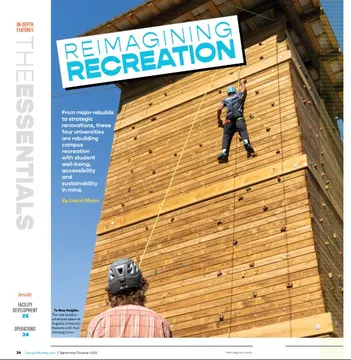
CDI Project Featured In Campus Recreation Magazine