Pedestrian Suspension Bridge Design & Construction
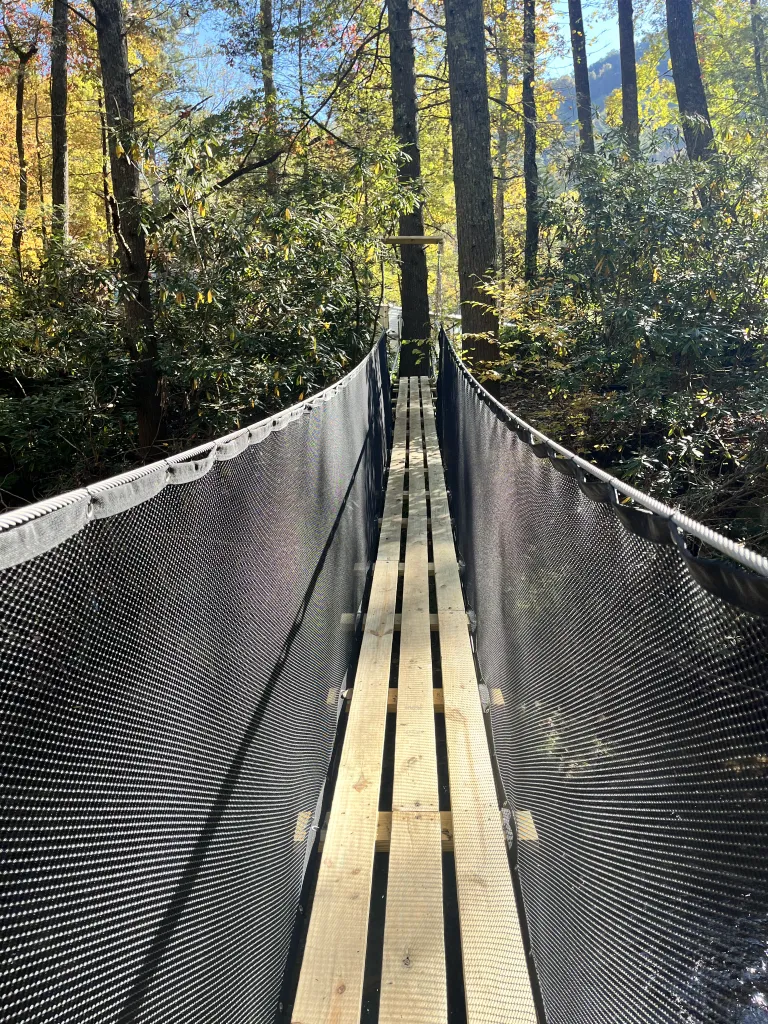
Challenge Design Innovations designs and builds custom pedestrian suspension bridges for parks, trail systems, municipalities, resorts, camps, universities, commercial attractions, and other public and private properties.
Whether you need to cross a creek, ravine, wetland, trail corridor, or dramatic landscape, a suspension bridge can provide practical access while becoming a memorable part of the property itself.
CDI can help take your project from an early idea through site evaluation, design, engineering coordination, construction, and long-term inspection and maintenance.
[Talk With CDI About Your Bridge Project]
Pedestrian Bridges Built for Your Site
Every bridge starts with the crossing.
The right design depends on much more than the distance between two points. CDI looks at how the bridge will be used, who will use it, what lies underneath it, and how the surrounding site affects construction.
We consider factors such as:
- Bridge span
- Elevation change
- Terrain
- Creek or drainage areas
- Existing trails and approaches
- Expected pedestrian traffic
- Desired bridge width
- Site access
- Foundation and anchoring conditions
- Handrails and containment
- Decking materials
- Appearance
- Maintenance access
- Environmental conditions
The result is a bridge designed around the property instead of forcing the property to fit a standard structure.
Where Pedestrian Suspension Bridges Work Well
Suspension bridges can work in places where a traditional pedestrian bridge may be difficult, visually intrusive, or less practical.
Common applications include:
- Parks and greenways
- Hiking and mountain bike trail systems
- Municipal recreation areas
- Resorts
- Campgrounds and RV resorts
- Summer camps
- Colleges and universities
- Retreat centers
- Nature centers
- Zoos
- Outdoor attractions
- Adventure parks
- Private developments
A bridge may serve a purely functional purpose, connecting two sections of a trail or property.
Or it can become an attraction itself.
A well-placed suspension bridge can create a viewpoint, connect guests with a part of the property that was previously difficult to reach, and add an experience people remember.
Custom Suspension Bridge Design
CDI does not approach every pedestrian bridge the same way.
Your bridge can be designed around your site's terrain, aesthetics, intended traffic, and surrounding environment.
Depending on the project, design decisions may include:
- Clear bridge width
- Span length
- Decking type
- Cable configuration
- Rail and side protection
- Towers or support structures
- Entry and exit platforms
- Approach trails
- Gates or access control
- Architectural details
- Materials and finishes
We can also consider how the bridge connects to other features on your property.
For example, a pedestrian suspension bridge might connect hiking trails, observation areas, towers, adventure attractions, or separate sections of a park.
From Site Evaluation to Construction
A successful pedestrian suspension bridge begins long before materials arrive on site.
-Site & Feasibility Review
We start by understanding what you are trying to cross and why.
Photos, maps, surveys, topographic information, and site plans can help with the initial conversation. For more advanced projects, an on-site evaluation may be appropriate.
-Design & Engineering Coordination
Once the concept is established, CDI develops the bridge design and coordinates the engineering needed for the project.
Engineering requirements can vary based on location, bridge configuration, intended use, foundations, local requirements, and other site-specific conditions.
-Construction
Our construction team brings the design into the field.
Because CDI regularly works on difficult terrain, elevated structures, zip lines, challenge courses, observation towers, and other outdoor structures, our team is accustomed to projects where access is not always simple.
That experience can be especially useful when building across ravines, streams, slopes, or remote sections of a property.
More Than a Bridge Contractor
Challenge Design Innovations has been designing and building outdoor structures and elevated experiences for more than 45 years.
Our work includes:
- Pedestrian suspension bridges
- Observation towers
- Zip lines
- Aerial adventure parks
- Challenge courses
- Rappel towers
- Climbing structures
- Obstacle courses
- Custom outdoor structures
That background gives us a different perspective on pedestrian bridge projects.
We understand that the bridge needs to work structurally, but we also think about how people approach it, move across it, experience it, inspect it, and maintain it over time.
And our involvement does not have to end when construction is complete.
CDI can also assist with ongoing professional inspections, repairs, maintenance, and modifications.
[Talk With CDI About Your Bridge Project]
Invite CDI to submit an RFP
Pedestrian Suspension Bridge FAQs
How much does a pedestrian suspension bridge cost?
There is no standard price because bridge costs depend heavily on the site and design.
Major factors include span length, bridge width, foundations, anchoring, towers or supports, decking, engineering, site access, terrain, and the amount of construction required at each end of the bridge.
If you have a potential location, CDI can review the basic project information and help you understand what will drive the budget.
How long can a pedestrian suspension bridge span?
Possible span length depends on the bridge design, site conditions, engineering, intended use, and support and anchoring systems.
Rather than choosing a bridge based on a standard maximum span, CDI starts by evaluating the actual crossing.
Can you build a suspension bridge over a creek or ravine?
Yes. Creeks, ravines, valleys, drainage areas, and uneven terrain are common reasons to consider a pedestrian suspension bridge.
Site conditions, permitting, environmental requirements, and foundation locations will need to be evaluated as part of the project.
Can the bridge be designed for public use?
Yes. CDI can work on bridges intended for public parks, trail systems, resorts, attractions, campuses, and other facilities.
Public-use projects often require additional consideration of engineering, accessibility, traffic, railing, approaches, permitting, and local requirements.
Can a pedestrian suspension bridge have gates or access control?
Yes. If the bridge should only be accessible during operating hours, access gates or other control features can be considered during design.
Does CDI build pedestrian suspension bridges nationwide?
Yes. CDI works with clients across the United States and can coordinate projects from early planning through construction.
Start Planning Your Pedestrian Suspension Bridge
If you know where you want to cross, approximately how far it is, who will use the bridge, and what you want the bridge to accomplish, that is enough to start the conversation.
Send us your site information, photos, maps, or early plans.
We can help you determine what comes next.