ZipKEA Zip Line Braking & Retrieval Systems
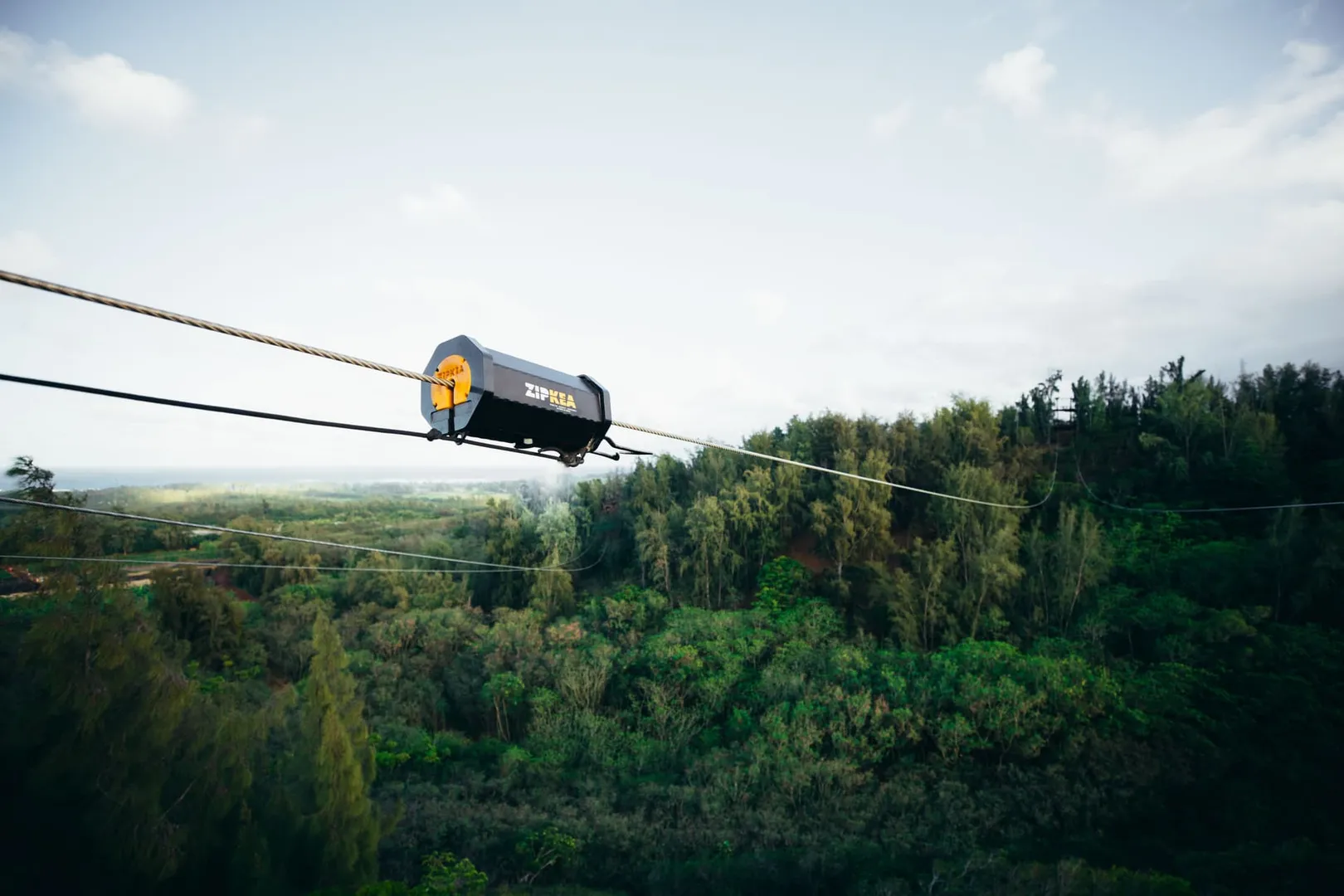
Some zip line riders arrive fast.
Some come up short.
And most arrive somewhere in between.
The Hackwell ZipKEA was designed to help operators manage all three.
Challenge Design Innovations can incorporate ZipKEA into new commercial zip line designs or evaluate your existing zip lines for a ZipKEA retrofit.
Unlike a brake that only addresses faster riders, ZipKEA combines primary braking and rider capture in one system. Faster riders can be slowed as they approach the platform, while riders who do not make it all the way to the landing area can be captured and pulled in.
For many operations, that solves two common zip line challenges with one piece of equipment.
What Is the ZipKEA?
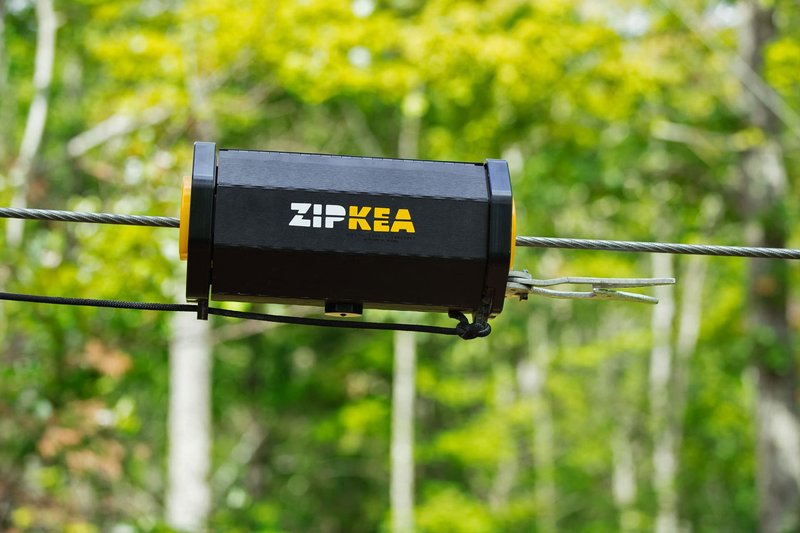
ZipKEA is a self-contained, self-regulating zip line braking and rider retrieval system manufactured by Hackwell Innovations.
The unit rides directly on the zip line cable and is positioned out on the line before the participant begins the zip.
When a faster rider reaches the ZipKEA, the system absorbs the rider's energy and provides braking. The faster the rider enters the system, the more stopping force the system applies.
If a slower rider does not reach the landing platform, the ZipKEA can capture the rider so staff can retrieve them.
And if a rider is arriving at an appropriate speed, the ZipKEA can be retracted so it does not unnecessarily interfere with the rider's arrival.
One system, different rider outcomes
Every rider is different.
Their weight, body position, weather conditions, cable conditions, and other factors can affect how they travel down a gravity-fed zip line.
ZipKEA gives operators another way to manage those differences.
Fast rider? The system provides braking.
Rider coming up short? The capture system helps bring them to the landing platform.
Rider arriving normally? The guide can move the ZipKEA out of the way quickly and easily.
That flexibility is one of the reasons ZipKEA can be particularly useful on gravity-fed commercial zip lines.
How Does ZipKEA Brake a Rider?
ZipKEA works differently from many traditional friction-based braking systems.
Hackwell describes the system as using the rider's kinetic energy to create the braking force. The wheels within the ZipKEA absorb that energy and use it to slow the rider without relying on the heat and friction associated with conventional friction braking.
The amount of braking also responds to the rider's arrival.
A faster rider generates greater braking force automatically.
That self-regulating behavior can help operators accommodate the speed differences that naturally occur between participants.
ZipKEA Also Captures Riders Who Come Up Short
Anyone who operates gravity-fed zip lines knows the other side of the speed problem.
Sometimes a rider simply does not make it to the platform.
Without a retrieval system, staff may need to send equipment out to the rider, move onto the cable themselves, or use another retrieval procedure to bring that participant to the landing area.
ZipKEA incorporates a rider capture system directly into the braking unit.
Hackwell designed its universal capture to attach to the participant's zip line trolley. Once captured, the rider can be pulled toward the landing platform.
That can make retrieving guests much more straightforward.
Designed for Gravity-Fed Zip Lines
ZipKEA is particularly well suited to zip lines with a negative slope.
Hackwell identifies negative-slope lines as the system's best-fit application because the ZipKEA can help manage faster arrivals while also capturing participants who stop short of the platform.
Flat and positive-slope lines may also be candidates, but those installations need additional evaluation.
That is important because no zip line braking product should be selected based on one specification alone.
CDI looks at the complete line before recommending a braking system.
Factors we evaluate include:
- Zip line length
- Cable slope
- Elevation change
- Cable tension and sag
- Expected rider speeds
- Rider weight range
- Landing platform configuration
- Available braking distance
- Participant trolley
- Guide positioning
- Rider retrieval procedures
- Emergency braking
- Daily operating procedures
The goal is not simply to install a ZipKEA.
It is to make sure the ZipKEA works correctly as part of the entire zip line system.
ZipKEA for Existing Zip Lines
One of the strongest features of ZipKEA is its retrofit potential.
Hackwell designed the system to install directly over an existing 1/2-inch zip line cable.
The cable does not need to be removed during installation, and the system does not require additional braking cables, poles, or external anchor points. Initial installation is performed by a Hackwell-approved Certified Installer like CDI.
That can make ZipKEA worth considering for operators who are happy with most of their existing zip line but want to improve braking, rider retrieval, or both.
Does that mean ZipKEA works on every existing zip line?
No.
Hackwell requires each course to be evaluated because zip lines vary significantly in their design, equipment, speeds, platforms, and operating procedures.
CDI can help you look at the complete system and determine whether a ZipKEA retrofit makes sense.
Sometimes the existing configuration is already a good candidate.
Other courses may need changes to cable geometry, landing areas, operating procedures, trolleys, or other components.
It is better to identify those issues before purchasing equipment.
Building a New Zip Line With ZipKEA
ZipKEA does not have to be an aftermarket upgrade.
It can also be considered during the design of a new commercial zip line.
Starting with the braking system in mind allows CDI to consider:
- Expected arrival speeds
- Landing platform length
- Brake positioning
- Rider retrieval
- Guide work areas
- Emergency braking
- Cable profile
- Trolley compatibility
- Participant weight ranges
- Inspection access
That gives us more flexibility than designing the entire zip line first and trying to fit the braking system into whatever space remains.
ZipKEA 8-Wheel vs. ZipKEA XL 12-Wheel
Hackwell currently offers two primary ZipKEA configurations.
■ ZipKEA 8-Wheel
The standard 8-wheel ZipKEA is intended for applications with more moderate arrival speeds.
Hackwell currently lists:
- 1/2-inch cable compatibility
- Maximum rider weight of 280 lbs.
- Maximum impact speed of 25 mph
- Recommended average speeds below 15 mph
- Universal rider capture system
■ ZipKEA XL 12-Wheel
The ZipKEA XL adds additional braking capacity for higher-speed applications.
Hackwell currently lists:
- 1/2-inch cable compatibility
- Maximum rider weight of 280 lbs.
- Maximum impact speed of 32 mph
- Recommended average speeds below 20 mph
- Universal rider capture system
These numbers are useful when evaluating the product, but they are not enough by themselves to determine which system your course needs.
Actual rider speeds, cable profile, braking distance, operating procedures, and other factors still matter.
CDI can help evaluate those pieces together.
Daily Inspection and Maintenance
ZipKEA is life-safety equipment and needs regular inspection and maintenance.
Hackwell requires operators to conduct daily inspections that include a visual check, wheel inspection, glide test, and pull test.
Wheels and other wear components also need to be replaced as required. How frequently that happens depends on factors such as participant volume and rider speeds.
Replacement components currently available from Hackwell include items such as:
- Wheels
- Capture components
- Covers
- Bumpers
- Rope
- Curtain clips
Your braking equipment should also be considered as part of the larger inspection program for the entire zip line.
CDI provides professional inspections, maintenance, and repairs for commercial zip lines and challenge courses.
Annual ZipKEA Recertification
ZipKEA also requires annual recertification.
The unit must be returned to Hackwell before the date shown on its recertification label.
During that process, Hackwell performs a more extensive inspection and replaces internal components as necessary, including items such as wheels, wheel kits, bearings, and magnets.
For year-round operations, Hackwell recommends considering an extra unit that can be rotated into service while another ZipKEA is being recertified.
Planning for that service cycle ahead of time can help minimize operational disruption.
What About an Emergency Brake?
Primary braking and emergency braking should be considered separately.
Hackwell also manufactures the Autoprusik 2.0, a passive emergency arrest device that automatically activates a prusik when contacted by a rider.
Depending on the course, CDI identifies either the Autoprusik alone or a combination of ZipKEA and Autoprusik as possible emergency arrest device configurations.
CDI can look at both your normal braking system and the independent emergency arrest strategy when designing or modifying the zip line.
The goal is a complete system, not simply one piece of braking equipment.
Why Work With CDI on a ZipKEA Project?
Challenge Design Innovations has been designing and building commercial zip lines, challenge courses, and aerial adventure facilities for more than 45 years.
We understand that changing a brake can affect much more than the brake itself.
CDI can assist with:
- Existing zip line evaluations
- New zip line design
- ZipKEA system integration
- Cable and structural evaluation
- Landing platform design
- Braking zone design
- Emergency braking
- Rider trolley selection
- Construction
- Course modifications
- Staff training
- Professional inspections
- Maintenance and repairs
And because we work with multiple zip line braking technologies, we can help determine whether ZipKEA is actually the right solution for your course.
Sometimes it will be.
Sometimes another braking approach will make more sense.
That decision should come from the needs of your operation and the design of your zip line.
Frequently Asked Questions About ZipKEA
Is ZipKEA a zip line brake?
Yes. ZipKEA is a self-regulating primary zip line braking system. It also incorporates a rider capture and retrieval function.
Can ZipKEA retrieve riders who stop short?
Yes. Rider capture is one of ZipKEA's primary features. The capture connects to the rider's carabiner so the participant can be pulled toward the landing platform.
Can ZipKEA be installed on an existing zip line?
Potentially. ZipKEA is specifically designed with retrofit applications in mind and installs over an existing compatible cable without removing the cable. However, Hackwell requires each course to be evaluated before approval.
What cable size does ZipKEA use?
1/2-inch cable is the one compatible for both the 8-wheel and 12-wheel XL ZipKEA models.
What is the ZipKEA rider weight limit?
The maximum rider weight is 280 pounds for both the 8-wheel ZipKEA and ZipKEA XL.
What is the maximum speed for ZipKEA?
The maximum impact speed is 25 mph for the 8-wheel ZipKEA and 32 mph for the 12-wheel ZipKEA XL.
Hackwell also recommends the 8-wheel model primarily for average speeds below 15 mph and the XL for average speeds below 20 mph.
Does ZipKEA need annual recertification?
Yes. Hackwell requires annual recertification. The unit is returned to Hackwell for inspection and replacement of internal components as necessary. Learn more at: https://www.challengedesign.com/manufacturer-gear-repair-inspections-and-recertifications/
Does ZipKEA work in cold weather?
Cold-weather conditions need additional consideration.
The ZipKEA does not function properly when ice is present on the cable and may have shorter stopping distances in temperatures below 32°F. Operators should follow the manufacturer's current requirements and operating instructions.
Is ZipKEA right for every zip line?
No.
ZipKEA works particularly well with certain negative-slope gravity lines, but every installation should be evaluated individually.
Your cable profile, rider speeds, landing area, trolley, participant weights, emergency braking system, operating procedures, and other factors all influence whether ZipKEA is a good fit.
Considering ZipKEA for Your Zip Line?
Whether riders are arriving too fast, stopping short, or you simply want to rethink how braking works on your course, we can help you evaluate the options.
Challenge Design Innovations can assess an existing zip line or design a new system with Hackwell ZipKEA incorporated from the beginning.
We will look at more than the brake.
We will look at the entire ride, from launch to landing.
Talk with CDI about your ZipKEA project and let us help determine whether it is the right braking and retrieval system for your course.